
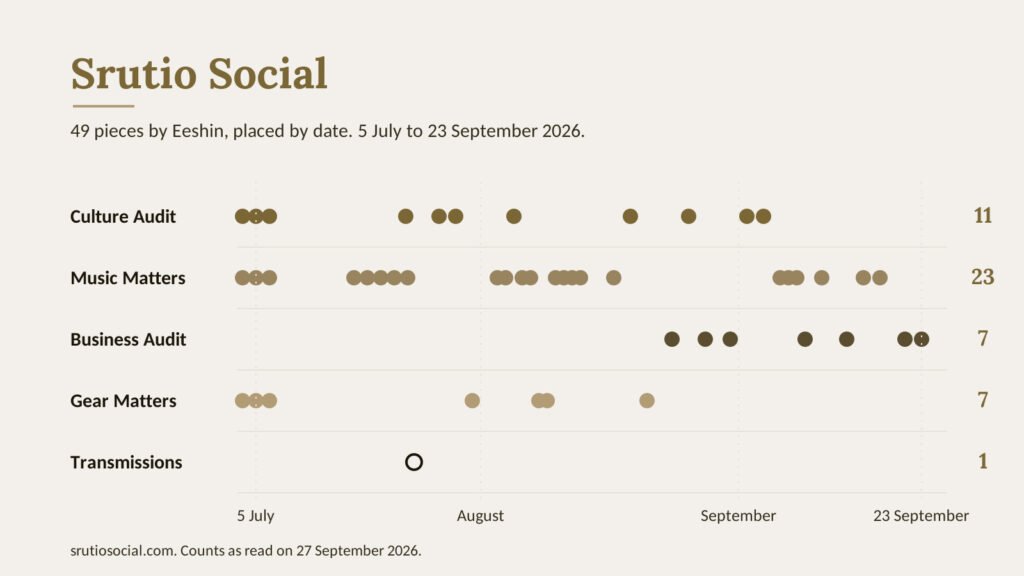
Srutio Social is a publication of Srutio Media And Software that reads music, film and art as evidence about work and culture. Every piece appears under one byline, Eeshin, at srutiosocial.com.
The archive opened on 5 July 2026 with essays built on Billy Joel, System of a Down and Led Zeppelin, which is an odd place to begin a study of the modern office. By late September it held more than forty pieces.
What the archive holds
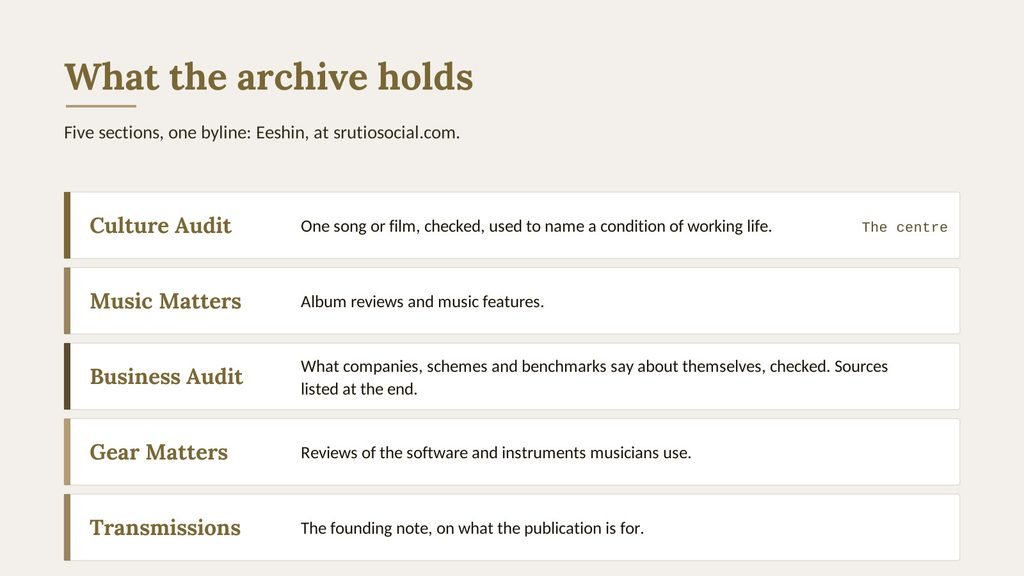
Culture Audit is the centre of the publication. Each essay takes one song or film, checks its facts and uses it to name a condition of working life that had no name before. A reader who has felt tired in a way a holiday does not fix will find a vocabulary for it here.
Music Matters holds album reviews and music features, from Mastodon to Big Big Train.
Business Audit checks what companies, schemes and benchmarks say about themselves, and every Business Audit ends with its sources, so a reader can test the claim without asking anyone.
Gear Matters reviews the software and instruments that musicians use, and Transmissions holds the founding note that explains what the publication is for.
Two concepts from the vocabulary
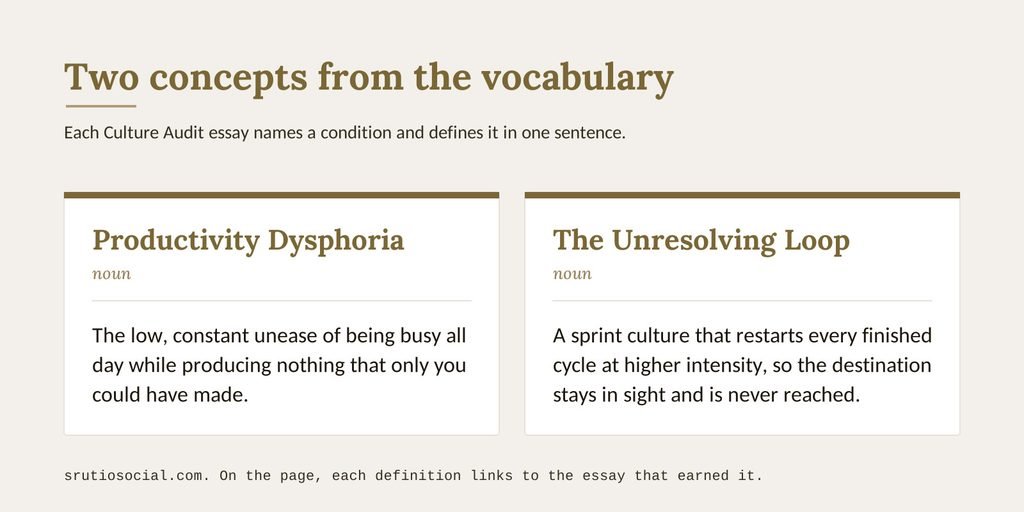
The founding note says that every Culture Audit essay introduces one or two named concepts and defines each in a single sentence, so that the name can be quoted and searched. Two examples show how that works.
Productivity Dysphoria is the low, constant unease of being busy all day while producing nothing that only you could have made.
The Unresolving Loop is a sprint culture that restarts every finished cycle at higher intensity, so the destination stays in sight and is never reached.
Each definition links to the essay that earned it, because a name without its example is only a label.
How the writing travels
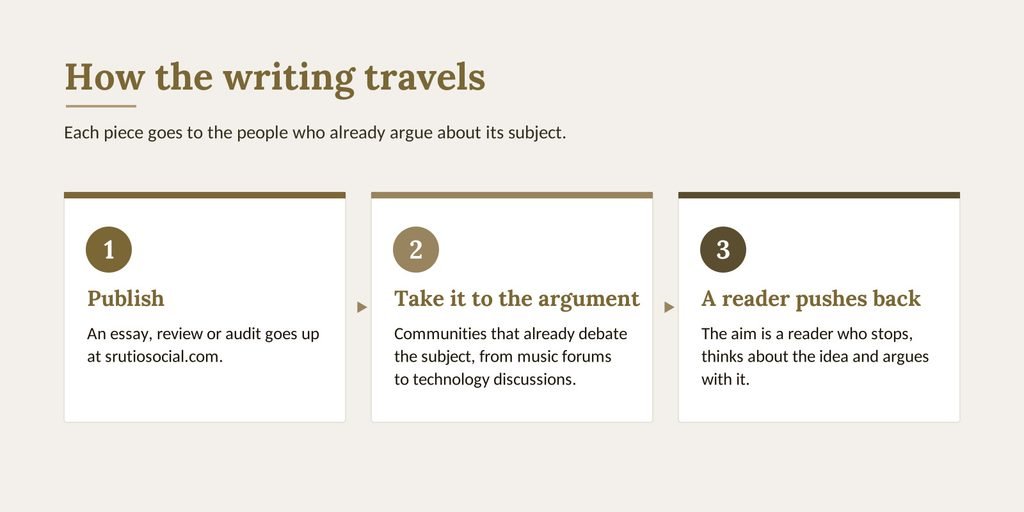
Srutio Social does not wait to be found. Each piece is taken to the online communities that already argue about its subject, music forums and technology discussions among them, and put in front of people who know the material well enough to disagree.
The aim is a reader who stops, thinks about the idea and argues with it, whether or not they end up agreeing. A room full of people thinking harder about a song is worth more to the publication than a room full of people nodding.
The byline
Every piece carries the byline Eeshin, a pen name that the founding note traces to a Bengali word for the observer. About Srutio introduces the person behind it.
Where to begin
Begin with Culture Audit for the vocabulary, with Music Matters for a verdict on a record, or with Business Audit for a check on a claim somebody published. New pieces also arrive by email list and by RSS feed.
Every piece stands alone.