
Swaran Labs is the software and technical wing of Srutio Media And Software. It builds Windows desktop software and writes technical e-books. Its scope is software of any kind, and the first two things it made both happen to concern sound.
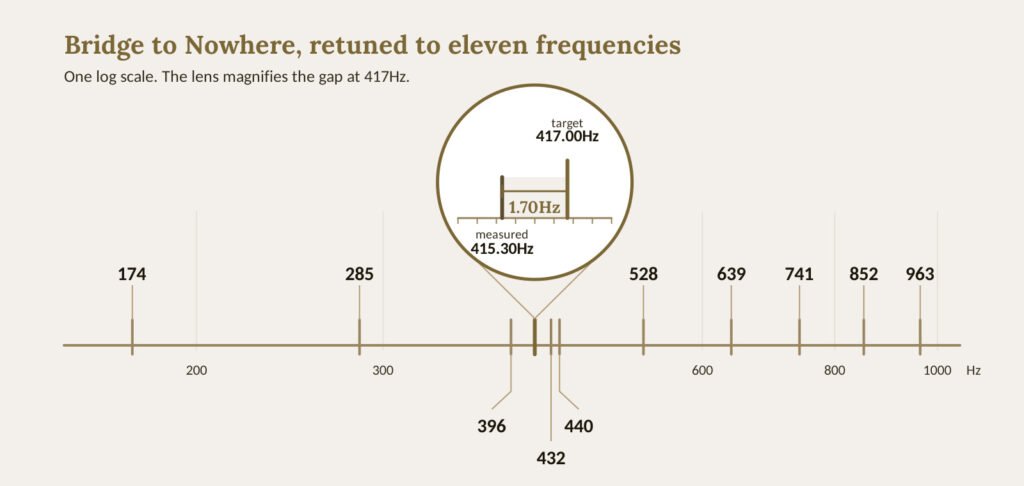
The software ends every conversion with a receipt. One of them belongs to a track called Bridge to Nowhere, retuned to 417.00Hz. It came back at 415.30Hz, and the receipt prints the 1.70Hz gap one line above the word PASS.
The Hz Receipt
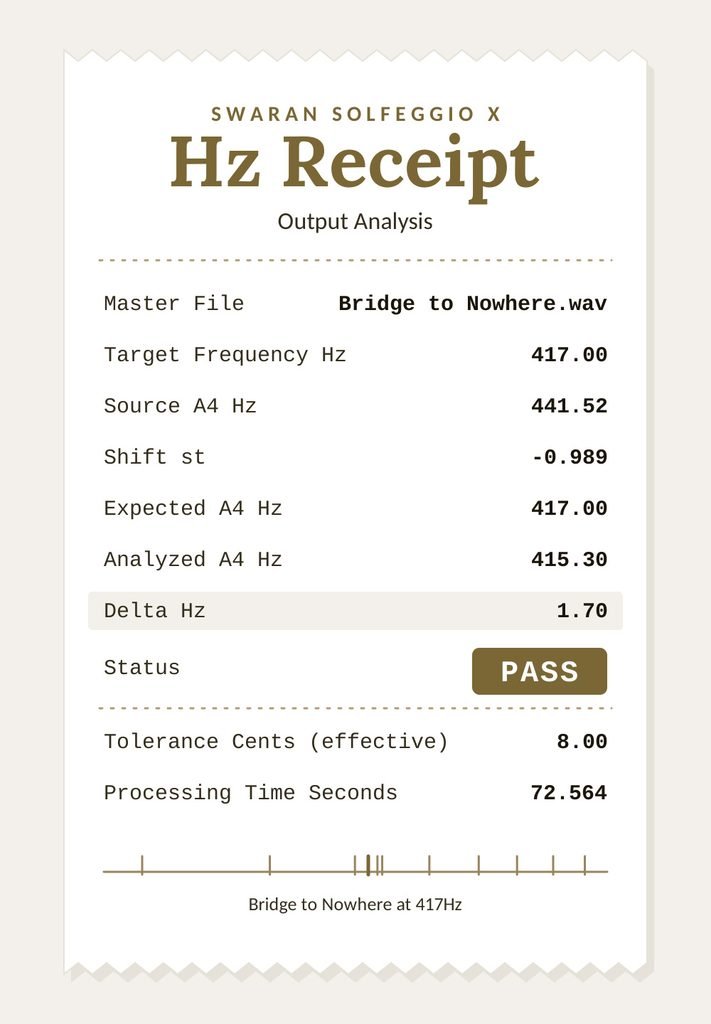
The image shows the receipt for that conversion, laid out as a receipt. In the software it is a plain-text file that sits beside the audio. Read from the top, it tells a small story.
The source sat near 440Hz, and the receipt records exactly where: its A measured 441.52Hz, so the software started from the number it found and never from the round one. It moved the pitch down 0.989 semitones toward 417.00Hz, measured what it made, and printed the distance from the target. The receipt does not round in its own favour, which is most of what a receipt is for.
The tolerance that applied, 8.00 cents, sits lower on the receipt. A cent is one hundredth of a semitone, and 1.70Hz at 417Hz is a little over seven of them, so the result lands inside the limit. For targets at or below 300Hz the tolerance is never tighter than 12 cents, and the receipt says so.
The same track was converted to all eleven targets, and each of the eleven files has a receipt of its own. Swaran Labs is publishing a video that plays the eleven versions back to back.
Swaran Solfeggio X
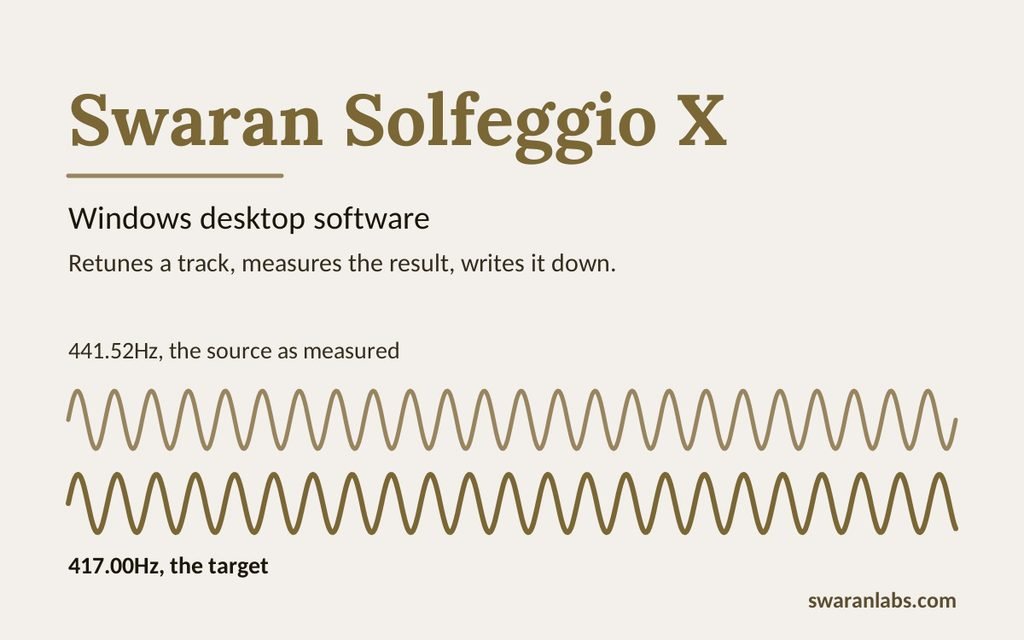
Swaran Solfeggio X is a Windows Workstation that retunes a track to the frequency you choose, measures what it made, and writes the result down. If it misses, it corrects itself and tries again.
The correction system is called Śruti Lock, after śruti, the classical Indian term for the smallest interval of pitch the ear can detect. That word is also the root of the name Srutio, and a company named for the smallest audible difference had better keep its own numbers straight.
It runs on Windows 10 and Windows 11, 64-bit, and your audio is processed on your own computer and never uploaded. There is no trial version. The purchase, the licence terms, the refund policy and the support route are all on swaranlabs.com, because this site sells nothing.
How To Produce Binaural Audio Effectively
This e-book runs to fourteen chapters and a glossary on placing sound around a listener on headphones, from the first track to the finished master. Eeshin wrote it for Swaran Labs, and it is free.
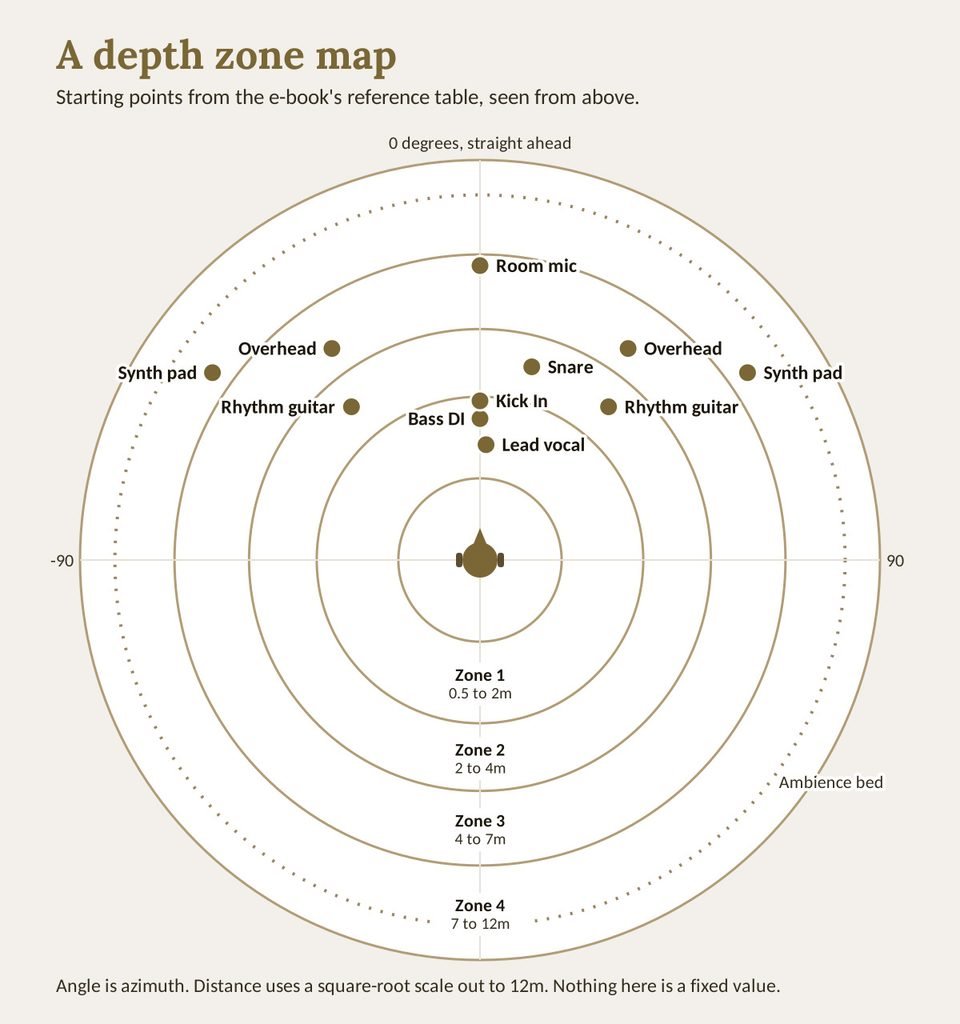
Its reference table gives a starting position for 58 instruments, and it says none wherever no processing profile honestly fits. The book explains why: an earlier draft filled every cell, and some of those numbers were not real.
The rules behind the table rest on how ears locate sound, by the tiny difference in arrival time at low frequencies and by the difference in loudness at high ones, a split that Lord Rayleigh described in 1907. Below roughly 150Hz, the book explains, the ear has almost nothing to go on for direction, which is why the table keeps the kick and the bass dead centre.
The workflow uses three plugins from other makers, two of them paid, and the book states each price as of writing. The plugins are not included. The download asks for an email address, and swaranlabs.com explains what happens to it.
Binaural audio, which places sound in space, is a different subject from binaural beats. The e-book covers the first and makes no claim about the second.
Where the frequencies come from
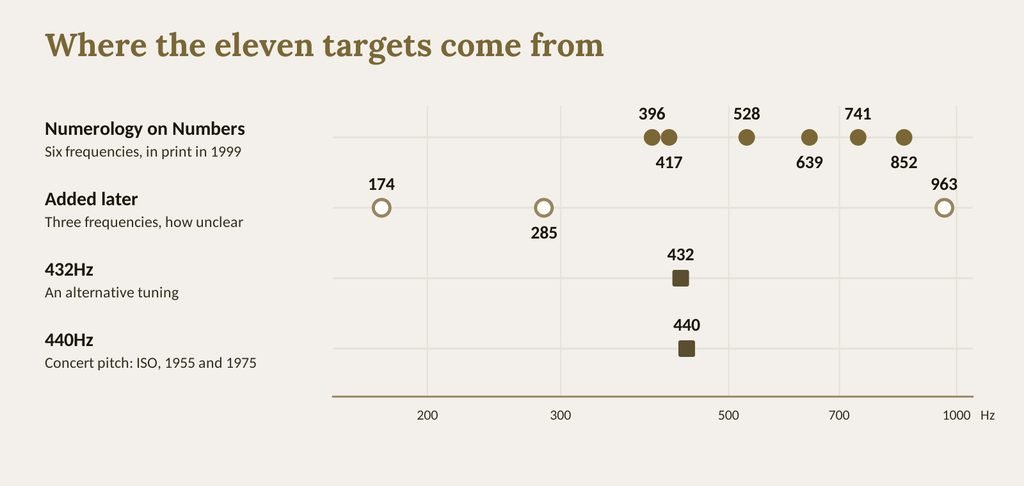
The Solfeggio frequencies have a shorter history than their name suggests. Six of them, 396Hz, 417Hz, 528Hz, 639Hz, 741Hz and 852Hz, come from numerology that Joseph Puleo applied to verse numbers in the Book of Numbers. They reached print in Healing Codes for the Biological Apocalypse, a 1999 book by Leonard Horowitz and Puleo. The other three, 174Hz, 285Hz and 963Hz, were added later, and how they were arrived at is unclear.
Two other targets have firmer histories. 440Hz became the international concert pitch through a recommendation of the International Organization for Standardization in 1955, made the standard ISO 16 in 1975, and 432Hz is an alternative tuning with a history of its own.
Swaran Solfeggio X treats all eleven as numbers to reach, and the Hz Receipt checks whether it got there. A receipt can settle a number. It cannot settle what a number does to a listener, and the software makes no claim about that.
Who builds it
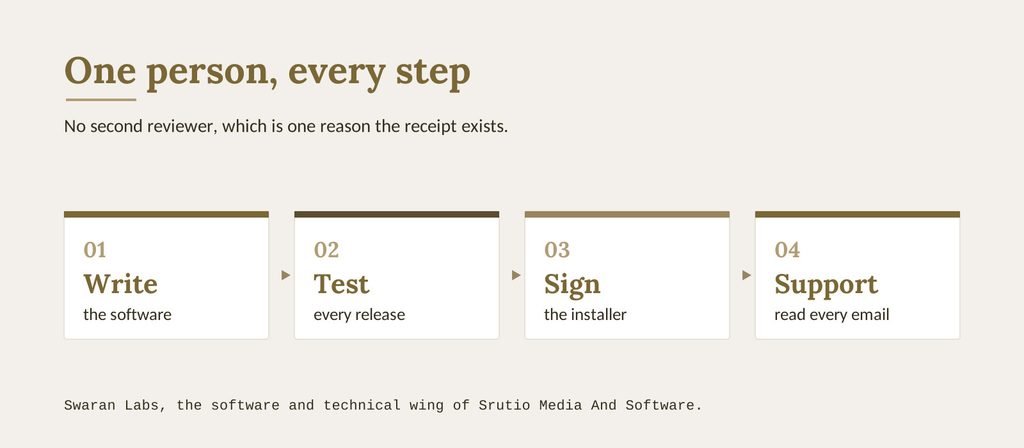
Swaran Labs is one person’s work. The same person writes the software, tests it, signs the installer and reads the support email. There is no second reviewer, which is one reason the receipt exists.
The same person also takes on custom software work for clients through Precision For Hire, held to the same rule: software should be able to show that it did its job.
Go to swaranlabs.com
Everything needed to buy, install or get help with a Swaran Labs product is on swaranlabs.com. Questions about working with Srutio go through Contact Srutio.
Start with the receipt.